The Democrats hysterical warnings about Russians under our beds, and Donald Trump's weird connection with poor, working class whites, are equally bizarre as long as you are using the archaic and obsolete left-right paradigm of democracy that we've been taught.
It finally occurred to me the other day that politics in 2016 can make perfect sense if you use the correct paradigm. That paradigm is feudalism.
It’s a classic peasant mentality: going into fits of groveling and bowing whenever the master’s carriage rides by, then fuming against the Turks in Crimea or the Jews in the Pale or whoever after spending fifteen hard hours in the fields. You know you’re a peasant when you worship the very people who are right now, this minute, conning you and taking your shit. Whatever the master does, you’re on board. When you get frisky, he sticks a big cross in the middle of your village, and you spend the rest of your life praying to it with big googly eyes. Or he puts out newspapers full of innuendo about this or that faraway group and you immediately salute and rush off to join the hate squad. A good peasant is loyal, simpleminded, and full of misdirected anger.
- Matt Taibbi
That the Democrats are fuming against the Russians in Crimea rather than the Turks is no more important than the votes of the Crimean people (again, and again, and again). It really doesn't matter what Russia is or is not doing. What matters is that Democrats salute and rush off to join the hate squad.
When you get down to it, loyal Democrats are furious at Russia for exposing how the corrupt Democratic Party elites were conning them and taking their shit, like good peasants.
However, when it comes to cons, the Democratic Party elites can't hold a candle to the Republican establishment.
In a sense, conservative voters have been groomed for Trump since the 1960s. As the historian Rick Perlstein wrote in The Baffler and The Nation in 2012, the American conservative movement has become more and more amenable to get-rich-quick schemes, snake-oil salesmen, and confidence men. Direct-mail barons like Richard Viguerie began raking in the dough in the 1960s by stirring up ideological hysteria and convincing an audience of senior citizens that only their small-dollar donation could fend off union bosses, abortionists, and gays. Of course, most of the money ended up with the fundraisers.
Conservative ideology, as Perlstein persuasively argues, is particularly vulnerable to grifters because of its faith in the goodness of business and its concomitant hostility toward regulation—which makes it easy for true believers to buy into the notion that some modern Edison has a miraculous new invention that the Washington elite is conniving to suppress. In Perlstein’s words, “The strategic alliance of snake-oil vendors and conservative true believers points up evidence of another successful long march, of tactics designed to corral fleeceable multitudes all in one place—and the formation of a cast of mind that makes it hard for either them or us to discern where the ideological con ended and the money con began.”
The only surprising thing about the victory of the grifter and snake-oil vendor, Donald Trump was that it didn't happen sooner.
"Why did so many working class Americans buy into the rhetoric of a billionaire philanderer ensconced in a penthouse in Manhattan with a long history of disdain for labor rights. Figuring that out is likely to be the stuff of many history books in future decades. One thought that comes to mind is that America has fallen so far and so fast at the hands of Wall Street that a slogan on a hat, “Make America Great Again,” was seized upon like a comfort food."
- Russ Martens
Matt Taibbi wrote about this phenomenon a few years ago.
The setup always goes the other way: when the excesses of business interests and their political proteges in Washington leave the regular guy broke and screwed, the response is always for the lower and middle classes to split down the middle and find reasons to get pissed off not at their greedy bosses but at each other. That’s why even people like Beck’s audience, who I’d wager are mostly lower-income people, can’t imagine themselves protesting against the Wall Street barons who in actuality are the ones who fucked them over.
Dividing the lower classes against one another is the ultimate objective of the ruling class of all feudal societies, and both the Democrats and Republicans use Identity Politics to do it.
Here's a good definition of identity politics.
The laden phrase “identity politics” has come to signify a wide range of political activity and theorizing founded in the shared experiences of injustice of members of certain social groups. Rather than organizing solely around belief systems, programmatic manifestos, or party affiliation, identity political formations typically aim to secure the political freedom of a specific constituency marginalized within its larger context. Members of that constituency assert or reclaim ways of understanding their distinctiveness that challenge dominant oppressive characterizations, with the goal of greater self-determination.
The key phrase here is "the shared experiences of injustice of members of certain social groups".
Everything about that phrase requires a full understanding of history - an Achilles heel of American society.
And there is the problem.
Few Americans actually know the history behind the social identities that the political movements revolve around.
This is a big deal.
If your political movement is based on symbolism that lacks historical context - without context it's not called history, it's called dogma - then your movement has more in common with religion than reality.
What's more, Americans know even less about the history of the oppressors they want to fight against.
This is important because the white male oppressor you are rebelling against might be Jewish or Irish, who's personal ancestry might include a lot more suffering than yours.
The Republican whipping boy right now are public school teachers, fire fighters, and other public servants. Why? Because they have stable jobs and middle class wages.
Republicans don't use the term "privilege" for their reasons to hate the Volvo-driving public school teacher because they can afford their mortgage.
But they hate them for a similar reason that liberals use the term "white privilege" - because the other group is getting something that they deserve.
And you know what? Republicans are right! They do deserve a middle class wage and some job security. But that doesn't mean that public school teachers don't.
Both Republicans and liberals are guilty of an extremely limited imagination of what the world should be, and a chronic lack of courage to see the world as it could be. But that's what peasants do.
It's disturbing to see both spectrums of political thought with such low expectations and so little vision that they cannot raise their heads to see the larger picture.
Even more importantly, both groups are also guilty of wrongly identifying the enemy.
Here's a good rule of thumb: if the people live on your block, go to your church, shop in your stores, or work in your workplace, then chances are they aren't the ones oppressing you.
If, on the other hand, they can purchase the politician you voted for, ship your factory overseas, and shape the economic, foreign and domestic policies of your country, then that's the group oppressing you..
Taibbi describes it as a "peasant mentality". I agree. However, Taibbi doesn't take the logical next step and tells us what it all means - neofeudalism.
In 1958 John Kenneth Galbraith wrote The Affluent Society. It was a book far ahead of its time, and one of the first to use the term "neo-feudalism". It dared to question traditional attitudes towards economics, and for that it was hated and shunned by wealthy conservatives.
Inequality has been justified on many grounds, "principally noted for the absence of the most important reason, which is the simple unwillingness to give up what [the rich] have." Equality has been argued to lead to uniformity and monotony (the rich sponsor the arts and education), redistribution has a musty association with godless communism, and the original Ricardian defense was that the present system was ultimately inevitable, and any attempt to change it would only lead to short-run inefficiency which would make everybody worse off.
This attitude, that some amount of suffering is necessary in the current system, and that any major changes in it would be self-defeating, is what I call Sacrificing to the Volcano God. We have turned economics into a religion, where the mistakes are common, yet the fundamental assumptions it is based on is beyond question. Gaping flaws in logic are ignored, or even held up as unanswerable mysteries that laymen could never understand. When the Volcano God rains ash and lava upon us, it is because we angered the Volcano God with our sins of minimum wage laws, child labor laws, environmental regulations, and worker safety laws. More sacrifices are needed or the Volcano God will destroy us all.
The High Priests of Economics never explain exactly how these sacrifices will fix the economy, nor do they mention that the sins in question might be their own. Yet we still rush to offer up our children's futures through unpayable debts while never considering that there might be better alternatives.
"Jesus Christ is Free Trade, and Free Trade is Jesus Christ."
- Dr. Robert Browning
Like the Volcano God, nothing can stop globalization. There is no alternative.
Besides, globalization is good. They tell us that it creates jobs, and you are expected to believe them even while you watch all the factories in your town close down and get sent overseas.
"Outsourcing is just a new way of doing international trade."
- N. Gregory Mankiw, chairman of Bush's Council of Economic Advisors
This shouldn't surprise anyone. David Ricardo, legendary economist and free-trade proponent, explained how this dynamic worked nearly two centuries ago.
"If instead of growing our own corn... we discover a new market from which we can supply ourselves... at a cheaper price, wages will fall and profits rise. The fall in the price of agricultural produce reduces the wages, not only of the laborer employed in cultivating the soil, but also of all those employed in commerce or manufacture."
- David Ricardo, Des principes de l'economie politique et de l'impot, 1835
So you see, your wages are supposed to fall with free trade globalization. Those who worship the Volcano God knew this all along. They also knew that our manufacturing base was going to move south of the border when NAFTA was passed. They fail to differentiate between free trade and global labor arbitrage.
I never understood how the wealthy elite could think that the impoverishment of the working class could be a good thing until I ran across the story of Plutus the other day.
Plutus, the God of Wealth, was blinded by Zeus so that he would be able to dispense his gifts without prejudice for things like need. When a couple citizens of Athens decide to give Plutus back his sight, the Goddess of Poverty intervenes. She tells them that she is the source of all progress in the world, and that if poverty was eliminated it would destroy civilization.
That's when I realized that the High Priests of Economics aren't actually worshiping a Volcano God. They are worshiping the Goddess of Poverty.

"Thus you dare to maintain that Poverty is not the fount of all blessings!"
- Goddess of Poverty, 388 B.C.
"In a little time [there will be] no middling sort. We shall have a few, and but a very few Lords, and all the rest beggars."
–R.L. Bushman
Neofeudalism is a concept in which government policies are designed to systematically increase the wealth gap between rich and poor while increasing the power of the rich over the poor. It's a party-neutral idea. There is no cabal pushing the plan, merely the sum effect of pressure from the wealthy elite.
Those policies can be seen today. Just look at the fact that earned income are taxed at a higher rate than unearned income, and the repeal of the inheritance tax. Other ways are harder to measure but no less real, such as white collar criminals receiving slaps on the wrist, while the poor feel the full weight of the law. It's a system with two sets of rules, one for the rich another one for the poor, and that is the definition of neofeudalism.
Another manifestation of neofeudalism is the growing power of corporations, that leave the poor dependent on private interests more powerful than the government, a situation resembling traditional feudal society.
Noam Chomsky in Hegemony or Survival had this to say:
If working people depend on the stock market for their pensions, health care, and other means of survival, they have a stake in undermining their own interests: opposing wage increases, health and safety regulations, and other measures that might cut into profits that flow to the benefactors on whom they must rely, in a manner reminiscent of feudalism.
Neofeudalism isn't just about the powerful taking over everything. It's about conditioning the poor to accept their designated role in society, even fighting to defend the ability of the wealthy to exploit them. It requires working people to do things that are against their own interests, and nowhere is this more true than in our current economic system.
The Blue-Collar Billionaire
Nothing seems more bizarre than poor, working-class whites identifying with a privileged, narcissistic, billionaire, con-man.
At least it's bizarre until you put it into the feudal paradigm.
First let's establish the feudal system hierarchy.
In reality, the power of monarchs varied greatly. Some had to work hard to maintain control of their kingdoms. Few had enough wealth to keep their own armies. They had to rely on their vassals, especially nobles, to provide enough knights and soldiers. In some places, especially during the Early Middle Ages, great lords grew very powerful and governed their fiefs as independent states. In these cases, the monarch was little more than a figurehead, a symbolic ruler who had little real power.
In most cases, the monarch was a distant, almost mythical figure to yeomen and serfs, while the actual oppressor, tyrant, and often tax collector in their lives were the large landholding lords and clergy.
In feudal society the monarch and his family was the 0.01% while the large landholding barons were the top 10%.
What does that have to do with Trump?
Look at his $14 Billion cabinet. It's the 0.01% written large.
“In the realm of politico-financial power and in Trump’s experience and ideology, the one with the most toys always wins. So it’s hardly a surprise that his money- and power-centric cabinet won’t be focused on public service or patriotism or civic duty, but on the consolidation of corporate and private gain at the expense of the citizenry.”
- Nomi Prins
On the other side of the coin are the Democrats and the professional class, the top 10%.
The first piece of evidence is what’s happened since the financial crisis. This is the great story of our time. Inequality has actually gotten worse since then, which is a remarkable thing. This is under a Democratic president who we were assured (or warned) was the most liberal or radical president we would ever see. Yet inequality has gotten worse, and the gains since the financial crisis, since the recovery began, have gone entirely to the top 10 percent of the income distribution.
This is not only because of those evil Republicans, but because Obama played it the way he wanted to. Even when he had a majority in both houses of Congress and could choose whoever he wanted to be in his administration, he consistently made policies that favored the top 10 percent over everybody else.
To the one third of abandoned Americans barely hanging on by their fingernails there is no real difference between the 10% and the 0.01%.
However there is a difference how the two groups talk to the lower classes, and thus are viewed.
As economist Mark Blyth pointed out, the political group representing the top 10% views the bottom third of America as "something to be policed and excluded" and "have their behaviors changed."
The Democratic and the professional elites are an easy and often amusing target. One could see them, in another era, prancing at a masked ball at Versailles on the eve of the revolution. They are oblivious to how hated they have become.
On the other end of the spectrum is the party of the 0.01%, the party of Trump, which spoke in terms of noblesse oblige. Trump has promised to defend the poor and powerless working class from things like TPP and foreigners, just like the monarchs of old. No wonder they voted for him.
A casual glance at the peasant revolts of the late Middle Ages will reveal that they rarely rebelled against the monarch. In many cases the peasants appealed to the monarch to save them from the brutality and rapaciousness of the barons.
Of course the monarch never did save them, not even once. The monarch needed the barons to control the peasants, but it showed the mindset of the peasants and who they considered their oppressors.
A good example of this was the Great Peasant Rising of 1381.
When it comes to thievery and abuse of power, nothing much changes unless the people rise up and stop it.
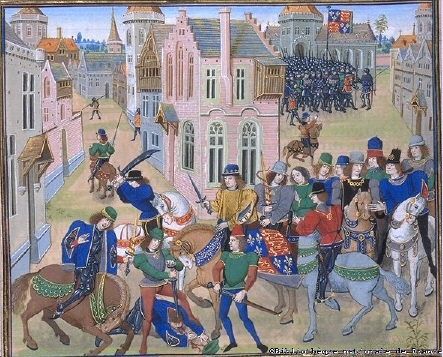
The simple peasants who marched on London believed that they were going to "explain their grievances to the King, who had been badly advised, and that all would be set right."
The leaders were more ambitious.
Personal freedom, free land and free trade: in granting these rebel demands Richard endorsed a revolution so profound that it is impossible to believe he was sincere – after all, serfdom was so entrenched that it would linger on in England well into the 16th century. Surely, then, Richard had no intention of being held to his promises and the Mile End meeting was simply a charade to gain time to suppress the revolt?
The king’s attitude towards the rebels is well known. “Rustics you were and rustics you are still,” the chronicler Thomas Walsingham reports him saying later to an Essex deputation seeking confirmation of their liberties. “You will remain in bondage, not as before but incomparably harsher. For as long as we live… we will strive with mind, strength and goods to suppress you so that the rigour of your servitude will be an example to posterity.”
The right-wing peasants of today will soon learn a similar, harsh lesson of where lie the loyalties of the elites.
Trump has no intention of vanquishing the foreign demons and domestic heretics, and that's the problem.
The corporate elites failed to grasp that a functioning liberal class is the mechanism that permits a capitalist democracy to adjust itself to stave off unrest and revolt. They decided, not unlike other doomed elites of history, to eradicate the liberal establishment after they had eradicated the radical movements that created the political pressure for advancements such as the eight-hour workday and Social Security....
The problem is not the liberal elites. The problem is the elites. They serve the same ideology. They work in the same financial institutions, hedge funds and foundations, including the Council on Foreign Relations, where government officials often are parked when they are out of power. They belong to the same clubs. They are stunted technocrats who function as systems managers for corporate capitalism. And no class of courtiers, going back to those that populated the Ottoman palaces, Versailles or the Forbidden City, has ever transformed itself into a responsible elite. They are, as John Ralston Saul writes, "hedonists of power."
Unfortunately, the Peasant Revolt of 1381 failed just like every other peasant revolt, mostly because the peasants are almost never as ruthless as the elites.
All 1,500 rebel peasant leaders were executed or tortured to death.